

In 2026, project management tools continue to evolve, and Trello remains one of the most popular platforms worldwide. In this guide on yllyon, we provide a detailed breakdown of Trello Pricing 2026, including updated plans, costs, features, and tips to help individuals, teams, and businesses choose the best option.
What Is Trello and Why Trello Pricing 2026 Matters
Explain Trello as a project management tool and why understanding Trello Pricing 2026 is essential for productivity and budgeting.
Trello Pricing 2026 Plans Overview
Introduce all available pricing tiers:
-
Trello Free Plan
-
Trello Standard Plan
-
Trello Premium Plan
-
Trello Enterprise Plan
Trello Free Plan Features in 2026
Detail what users get with the free version:
-
Boards and cards
-
Basic automation
-
Limited integrations
-
Best use cases
Trello Standard Pricing and Features 2026
Cover:
-
Monthly and annual pricing
-
Advanced checklists
-
Custom fields
-
Team collaboration tools
Trello Premium Pricing 2026 Explained
Discuss:
-
Advanced views (Timeline, Dashboard, Calendar)
-
Unlimited automation
-
Enhanced security
-
Who should use Trello Premium
Trello Enterprise Pricing 2026 for Large Organizations
Explain:
-
Custom pricing model
-
Enterprise-level security
-
Admin controls
-
Scalability for global teams
Read also :
Trello Pricing 2026 Comparison Table
Include a comparison overview:
-
Price range
-
Automation limits
-
Security features
-
Best plan by team size
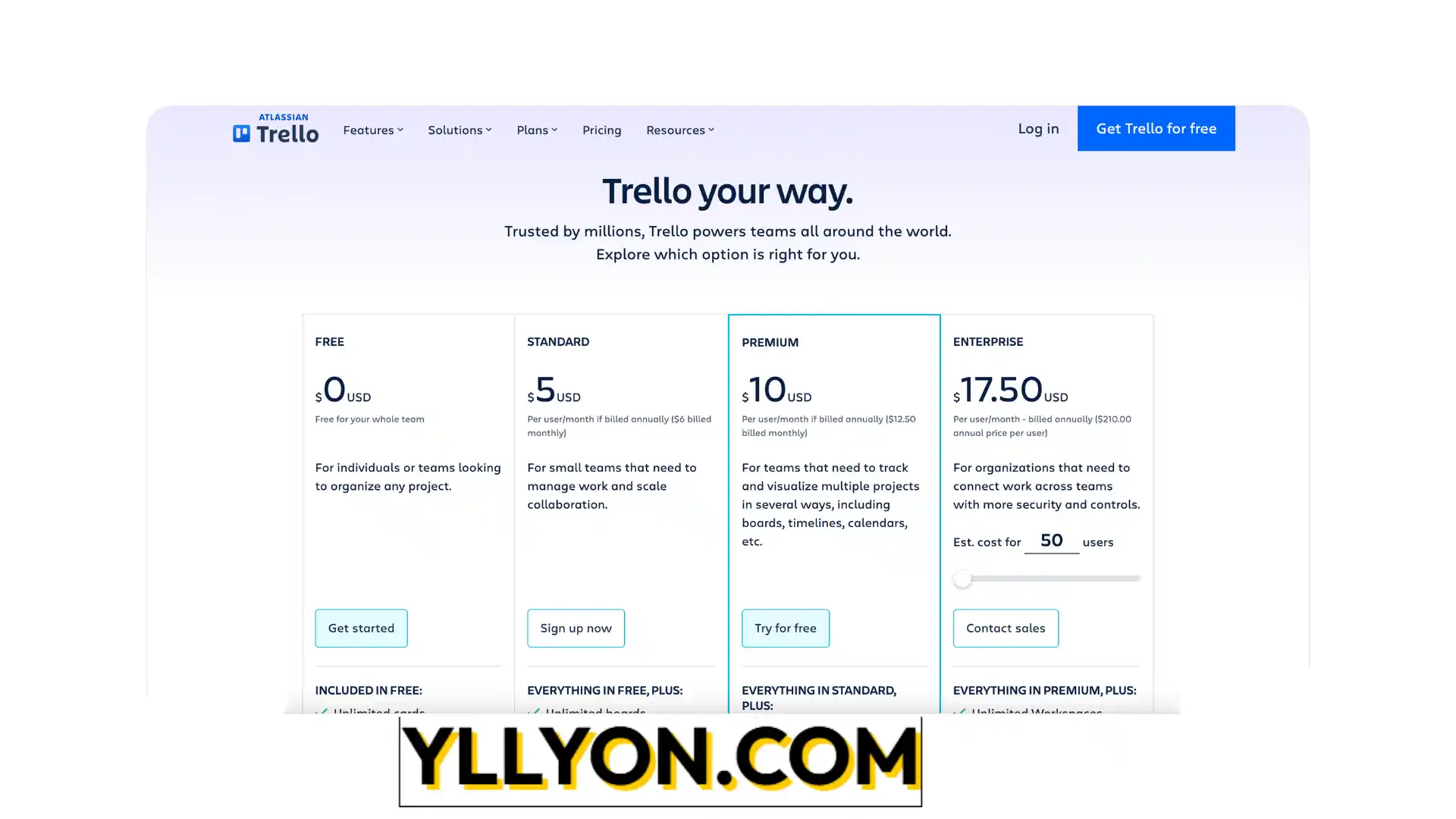
Trello Pricing 2026 Comparison Table
| Plan | Price (Per User/Month) | Best For | Key Features |
|---|---|---|---|
| Free | $0 | Individuals & small teams | Unlimited cards, up to 10 boards per workspace, basic automations, mobile apps, 2-factor auth (trello.com) |
| Standard | $5 billed annually ($6 billed monthly) | Small teams | Unlimited boards, advanced checklists, custom fields, 1,000 automation runs/month |
| Premium | $10 billed annually ($12.50 billed monthly) | Growing teams | Multiple views (Calendar, Timeline, Dashboard, Table, Map), unlimited automation, admin & security tools |
| Enterprise | $17.50 (annual pricing per user) | Large organizations | Org-wide permissions, unlimited workspaces, advanced security & controls |
How to Choose the Best Trello Plan in 2026
Provide guidance based on:
-
Individual users
-
Small teams
-
Growing startups
-
Large enterprises
Tips to Save Money on Trello Pricing 2026
Include:
-
Annual billing discounts
-
Free plan optimization
-
Educational and nonprofit offers
How does Trello compare to its competitors?
Initially, Trello functioned purely as a straightforward Kanban application, but it gradually expanded its feature set sufficiently to rival major platforms within the project management space.
A review of Trello’s specific strengths and weaknesses relative to alternative software is provided below.
Trello vs Jira Pricing (Detailed Comparison)
Both Trello and Jira are owned by Atlassian, but they serve different use cases. Trello focuses on simplicity and visual task management, while Jira is built for complex workflows, agile teams, and software development.
Pricing Comparison (Billed Annually)
| Plan | Trello Price | Jira Price | Best Use Case | Target Teams |
|---|---|---|---|---|
| Free | $0 | $0 | Basic task management | Individuals & small teams |
| Standard | $5 / user / month | $7.29 / user / month | Team collaboration | Small to medium teams |
| Premium | $10 / user / month | $14.17 / user / month | Advanced project tracking | Growing teams |
| Enterprise | $17.50 / user / month | POA | Enterprise-level control | Large organizations |
Trello vs Jira Free Plan Features (Expanded Table)
When comparing the free plans, Jira provides more advanced views and reporting tools, while Trello focuses on simplicity and flexible file handling.
Free Plan Feature Comparison
| Feature | Trello Free | Jira Free |
|---|---|---|
| User limit | 10 users per workspace | 10 users |
| Boards / Projects | Up to 10 boards | Unlimited projects |
| Cards / Issues | Unlimited cards | Unlimited issues |
| Timeline view | ❌ Not available | ✔ Available |
| Calendar view | ❌ Not available | ✔ Available |
| Dashboard reports | ❌ | ✔ |
| Workflow customization | Basic | Advanced |
| Automation | Limited | Limited |
| File storage | Unlimited (10 MB per file) | 2 GB total |
| Integrations | Limited Power-Ups | Limited apps |
| Mobile apps | ✔ iOS & Android | ✔ iOS & Android |
| Best for | Simple task tracking | Agile & software teams |
Key Differences at a Glance
| Aspect | Trello | Jira |
|---|---|---|
| Ease of use | Very easy | Moderate to advanced |
| Learning curve | Low | High |
| Agile tools | Basic | Advanced (Scrum, Kanban) |
| Reporting & analytics | Minimal | Powerful |
| Custom workflows | Limited | Highly customizable |
| Ideal users | Non-technical teams | Developers & product teams |
Final Takeaway
- Trello is perfect if you want a clean, visual, and easy-to-use tool for everyday task management.
- Jira is the better choice for teams that need detailed tracking, reporting, and agile project management features.
Securing Optimal Value and Pricing for Trello
To maximize your return on investment and achieve the most favorable pricing for Trello, consider the following strategies:
Initiate Use with the Free Plan
The complimentary Trello plan supports a maximum of 10 boards, includes two power-ups per board, and allocates 250MB for file attachments per board. This serves as an excellent opportunity for smaller teams and casual users to evaluate Trello’s core functionalities before committing financially. Utilizing the free tier assists in determining if Trello’s capabilities align with your team’s operational requirements.
Thoroughly Evaluate Paid Subscriptions
Trello’s paid tiers introduce expanded features beyond those available in the free version. The Standard plan grants unlimited boards, power-ups, and storage capacity for $5 per user monthly. This tier incorporates functionalities such as Custom Fields and enhanced checklist options.
The Premium plan begins at $10 per user monthly. Essential features for enterprise use include advanced administrative controls, mandatory two-factor authentication, and dedicated 24/7 priority support. Teams should assess their requirement for these supplementary security and oversight mechanisms before opting for the higher Enterprise subscription costs.
Choose Yearly Contracts
Trello provides reduced per-user rates for annual agreements compared to monthly billing cycles. Selecting a yearly subscription can result in substantial long-term cost reductions. Annual plans also fix the current price, safeguarding against potential increases upon renewal that occur monthly.
Utilize Non-Profit and Educational Rate Reductions
Validated non-profit organizations are eligible for discounts of up to 50% on paid Trello subscriptions. Educational bodies, including universities and schools, may also extend complimentary or heavily subsidized access to Trello for their students and faculty.
Access Bulk Discounts for Larger Organizations
Companies exceeding 100 users qualify for Trello’s tiered volume discounts, where pricing decreases progressively, offering up to 18% off for organizations surpassing 500 users. Larger teams can achieve maximum cost efficiency by utilizing these increasing volume discounts.
Pursue Individualized Agreements
Very large corporations might secure customized pricing arrangements directly through negotiations with the Trello sales department. Flexible enterprise contracts can further optimize expenditures on Trello for organizations managing 1,000 or more users.
Essential Functionalities of Trello
Trello facilitates task management in a remarkably straightforward and user-friendly manner. Below are several pivotal features that support efficient project oversight:
Members: Assign colleagues to specific cards to ensure clarity regarding individual responsibilities. This practice significantly improves accountability across ongoing initiatives.
Due Dates: Establish firm deadlines, activate notifications, and designate items as finalized. This functionality aids teams in successfully achieving critical project milestones promptly.
Attachments: Avoid searching through email inboxes for necessary documents. Users can effortlessly drag and drop files directly onto the corresponding cards for immediate retrieval.
Checklists: Divide complex assignments into manageable sub-tasks using checklists. Observing the progress bars fill up as items are completed provides motivation.
Boards: Trello boards offer a comprehensive overview of projects, adhering to the principles of the Kanban methodology. They visually track the progression of work from initial concept through final delivery.
Timeline: Project schedules are displayed clearly, allowing for easy comprehension. Users can also modify dates instantly via drag-and-drop functionality, assisting in adherence to primary objectives.
Calendar: Obtain a high-level perspective of scheduled tasks and upcoming events. This tool helps in planning projects and managing time effectively.
Rules: Implement automation for recurring activities using predefined rules and triggers. Trello manages these processes automatically, ensuring no detail is overlooked.
Buttons: Design bespoke buttons to streamline operational workflows. Execute several operations simultaneously with a single interaction.
Integrations: Link all preferred external applications directly within the Trello interface. Users can post updates to Slack or generate Jira tickets without needing to navigate away from the current screen.
Intelligent Tips: Butler identifies frequently repeated actions and proposes practical automation solutions to conserve time. Activation requires only a simple click.
Trillo’s most famous rivals
While Trello popularized the concept of card-based task organization, numerous competitors exist, each providing distinct methods for team collaboration.
Asana
Asana emphasizes adaptable task management, featuring useful timeline and calendar displays. It provides visual project boards, incorporating functionalities like customized fields, filtering options, dependency tracking, milestone setting, and comprehensive mobile applications. Asana is highly suitable for teams whose primary need is task-centric workflow management.
Monday.com
Monday.com delivers impressive visual boards heavily augmented by automation tools. Key offerings include customizable display options, automated operational workflows, application integrations, robust charting and reporting features, timelines, resource allocation management, and file storage. Its strong automation capabilities position Monday.com as an excellent choice for teams focused on eliminating repetitive labor.
Wrike
Wrike is distinguished by its proficiency in sophisticated scheduling and managing demand. It features Gantt charts, tools for workload regulation, project portfolio management, dependency mapping, resource planning, tailored dashboards, and powerful integration options. Wrike is a premier selection for intricate projects that necessitate detailed resource allocation strategies.
Basecamp
Basecamp focuses primarily on integrated communication and cooperative efforts. It consolidates features such as group messaging, shared documentation and schedules, task lists, and high-level project summaries. Basecamp’s inherent simplicity makes it ideal for teams prioritizing straightforward communication.
Jira
Jira excels in adaptable, ticket-based project monitoring, which is frequently favored by IT departments. Furthermore, it offers agile project management tools, detailed reporting, adjustable workflows, and precise permission settings. Jira is generally considered the leading alternative for software development teams.
Notion
Notion functions as a unified workspace that integrates documentation, notes, wikis, and tasks seamlessly. It features adaptable pages, databases, Kanban boards, calendars, charts, and fine-grained access controls. Notion provides a unique proposition for teams requiring linked knowledge management alongside their task organization.
ClickUp
ClickUp is a highly configurable project management platform loaded with features. It boasts multiple viewing modes, tailored fields and workflows, built-in chat and video conferencing, spreadsheet-style tracking, hierarchical folder structures, and robust security controls. ClickUp empowers teams to construct the exact workflow they require.
Airtable
Airtable merges the functionalities of spreadsheets, forms, and databases into a single collaborative interface. It provides linked databases, calendars, boards, submission forms, galleries, personalized automation features, and a high-quality mobile experience. For organizations requiring a mix of structured data management and project coordination, Airtable offers an innovative hybrid solution.
FAQ Section (No Question Marks)
How much does Trello cost in 2026
Answer with a general pricing range for all plans.
Is Trello free to use in 2026
Explain free plan limitations and benefits.
What is the difference between Trello Premium and Enterprise in 2026
Clarify advanced features and pricing differences.
Can teams upgrade or downgrade Trello plans in 2026
Explain flexibility in subscription management.
Is Trello Pricing 2026 worth it for businesses
Discuss ROI and productivity benefits.
Conclusion
Trello Pricing 2026 offers flexible plans designed for individuals, teams, and enterprises. Whether you need a free task board or an advanced enterprise solution, Trello provides scalable pricing to match your workflow. Follow this guide on yllyon to confidently select the best Trello plan for your needs.
 habdien12@gmail.com